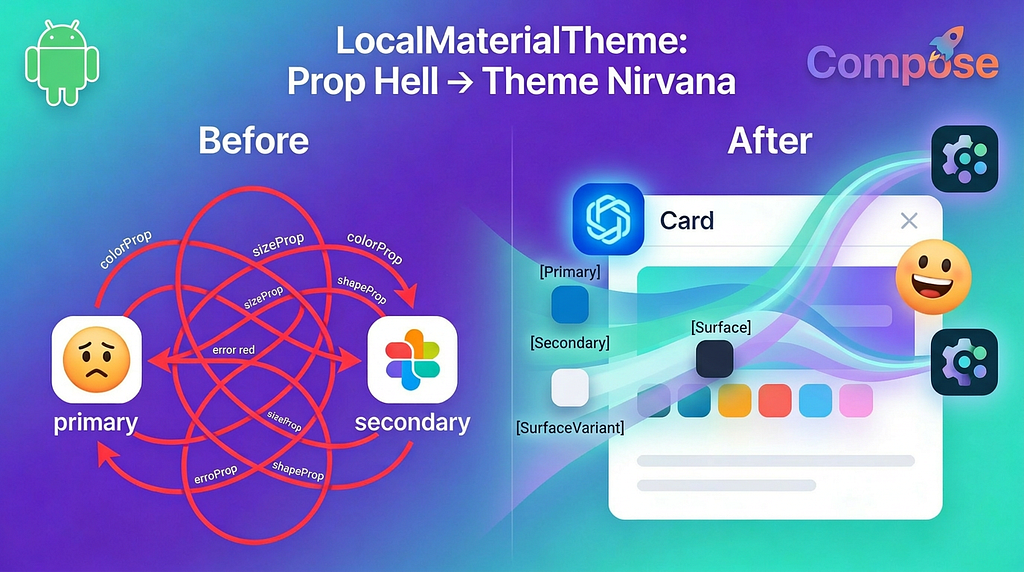

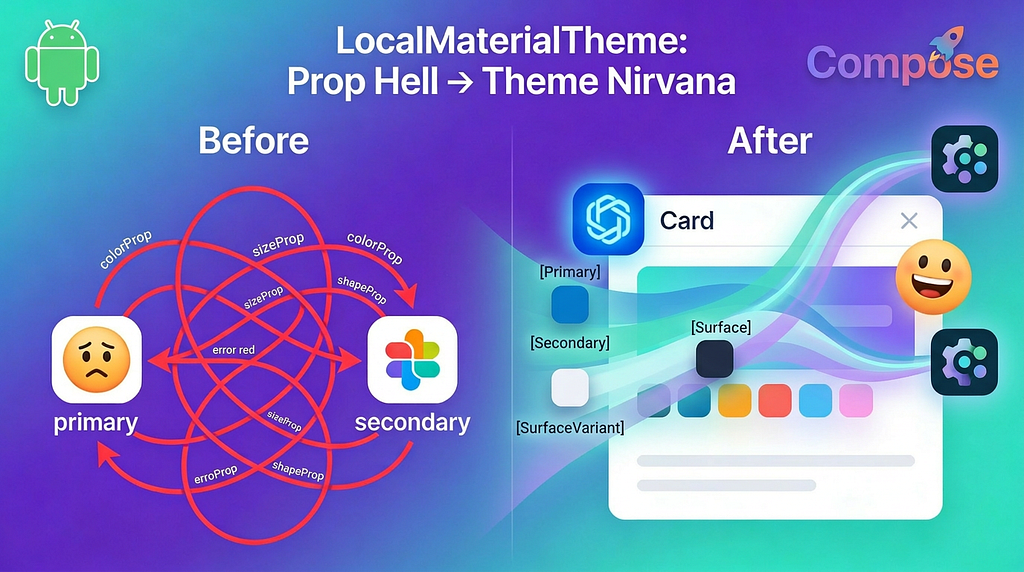
Jetpack Compose Material 3 1.5.0-alpha15 introduces a subtle but powerful refactor
MaterialTheme now uses a single LocalMaterialTheme CompositionLocal instead of separate locals for color, typography, shapes, and motion.
While this simplifies internal theme management, its real value emerges when building custom design systems and theme-aware Modifier libraries.
The Refactor: Cleaner Under the Hood
- Previously, MaterialTheme relied on multiple CompositionLocals:
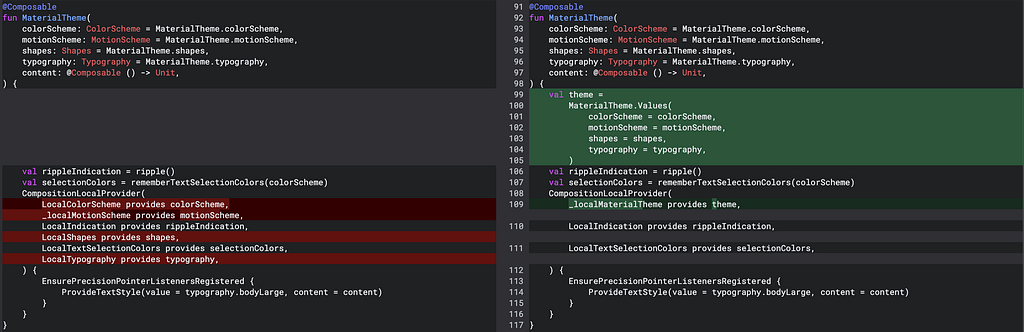
- Now: Everything flows through one unified source:
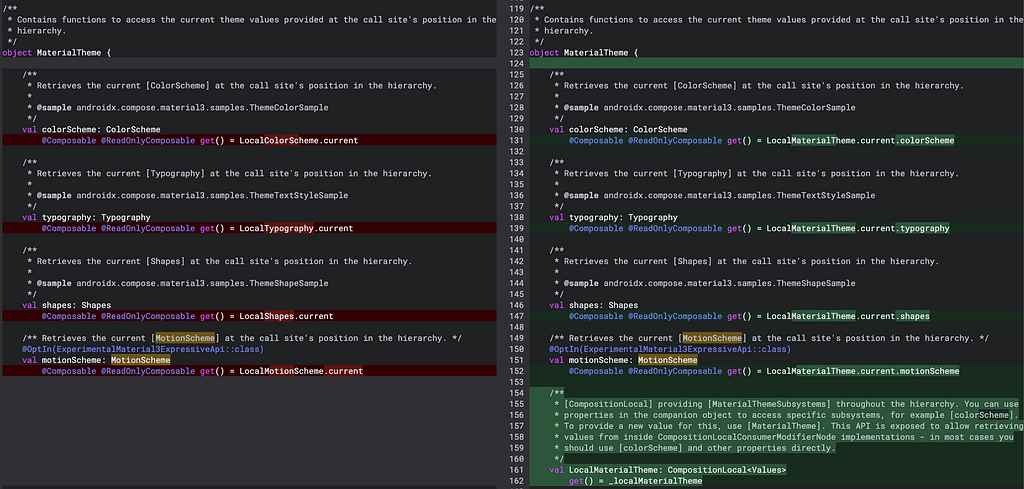
This reduces allocations and simplifies the theme provider.
⭐️ Where It Shines: Design Systems & Custom Modifiers ⭐️
The game-changer is CompositionLocalConsumerModifierNode support.
Custom Modifiers that handle drawing/layout outside @Composable scopes can now read theme data directly:
object BrandGradientOverlayElement : ModifierNodeElement<BrandGradientOverlayNode>() {

    override fun create(): BrandGradientOverlayNode = BrandGradientOverlayNode()

    override fun update(node: BrandGradientOverlayNode) {
        // No-Op
    }

    override fun InspectorInfo.inspectableProperties() {
        name = "brandGradientOverlay"
    }

    override fun equals(other: Any?): Boolean = (this === other)

    override fun hashCode(): Int = javaClass.hashCode()

}


class BrandGradientOverlayNode :
    Modifier.Node(),
    DrawModifierNode,
    CompositionLocalConsumerModifierNode {

    override fun ContentDrawScope.draw() {

        // Read color scheme to access colors
        val colorScheme =
              currentValueOf(MaterialTheme.LocalMaterialTheme).colorScheme

        val gradient = Brush.linearGradient(
            listOf(
               colorScheme.primary,
               colorScheme.secondary)
        )

        drawContent()
        drawRect(brush = gradient)
    }
}

// Modifier
fun Modifier.brandGradientOverlay(): Modifier =
    this then BrandGradientOverlayElement
Usage
@Composable
fun LocalMaterialThemeEx() {
    MaterialTheme {
        Card {
            Box(
                modifier = Modifier
                    .brandGradientOverlay()
            ) {
                Text("Sample LocalMaterialTheme")
            }
        }
    }
}

Before Unified LocalMaterialTheme
Before this change, CompositionLocalConsumerModifierNode couldn’t directly access the theme subsystems because there was no unified LocalMaterialTheme.
- Pass theme data via params
fun Modifier.brandGradientOverlay(
    // Manual prop from parent composable
    primaryColor: Color,
    secondaryColor: Color
): Modifier = drawWithCache {
    val brandGradient = Brush.linearGradient(
        0f to primaryColor,
        1f to secondaryColor
    )
    onDrawWithContent {
        drawContent()
        drawRect(brush = brandGradient)
    }
}

// Usage
Card(
    modifier = Modifier.brandGradientOverlay(
        primary = MaterialTheme.colorScheme.primary,
        secondary = MaterialTheme.colorScheme.secondary
    )
)
- Capture from Composable (Recomposition-Heavy).
fun Modifier.brandGradientOverlay(): Modifier = composed {
    // Captured here
    val colorScheme = MaterialTheme.colorScheme

    drawWithCache {
        val brandGradient = Brush.linearGradient(
            0f to colorScheme.primary,
            1f to colorScheme.secondary
        )
        onDrawWithContent {
            drawContent()
            drawRect(brush = brandGradient)
        }
    }
}
❌ When Not to Use It
// ✅ DO: Regular composables
@Composable
fun MyButton() {
    Button(colors = ButtonDefaults.colors(
        containerColor = MaterialTheme.colorScheme.primary // Works unchanged
    )) { }
}

// ❌ DON'T: Overcomplicate simple cases
@Composable
fun MyButton() {
    // No need for LocalMaterialTheme.current here
    val subsystems = MaterialTheme.LocalMaterialTheme.current
    Button(colors = ButtonDefaults.colors(
        containerColor = subsystems.colorScheme.primary
    )) { }
}
References
Compose Material 3 | Jetpack | Android Developers
Keep in touch
https://www.linkedin.com/in/navczydev/
LocalMaterialTheme: From Prop Hell to Theme Nirvana — Material3 was originally published in ProAndroidDev on Medium, where people are continuing the conversation by highlighting and responding to this story.



This Post Has 0 Comments